
Criminal Cases in the Banner County Courts
Banner County court records are split by jurisdiction, which means the legal power assigned to each court. Banner County Court handles misdemeanors, traffic matters, and the early phase of a felony. Those felony steps can include the first appearance, bond, the complaint, and a preliminary hearing. If the felony is bound over, the prosecution moves to Nebraska District Court. The District Court clerk then maintains the felony trial case under a separate district case number. A searcher may need both files to follow the full path.
The two clerks are also the source for the official documents behind an online event list. Dianne Lana serves as the Banner County Court clerk through P.O. Box 133, Gering, NE 69341, at 308-436-5268. Katie West serves as Banner District Court clerk through P.O. Box 67, Harrisburg, NE 69345, at 308-436-5265. Ask the proper clerk about pleadings, court orders, a judgment, a sentencing order, or a certified copy. Banner County does not have a municipal court or a city criminal docket.
Banner County Court Records in Gering
The county name on a case does not always reveal where the counter is staffed. Banner County Court is paired with Scotts Bluff County, so routine County Court business is available through the clerk in Gering. Arranged access may also occur in Harrisburg. District Court files remain centered in Harrisburg. This regional setup is vital for anyone planning to inspect a record or mail a copy request.
The official District 12 directory identifies the courts, clerks, and regional services that cover Banner County. Its directory view is shown below.
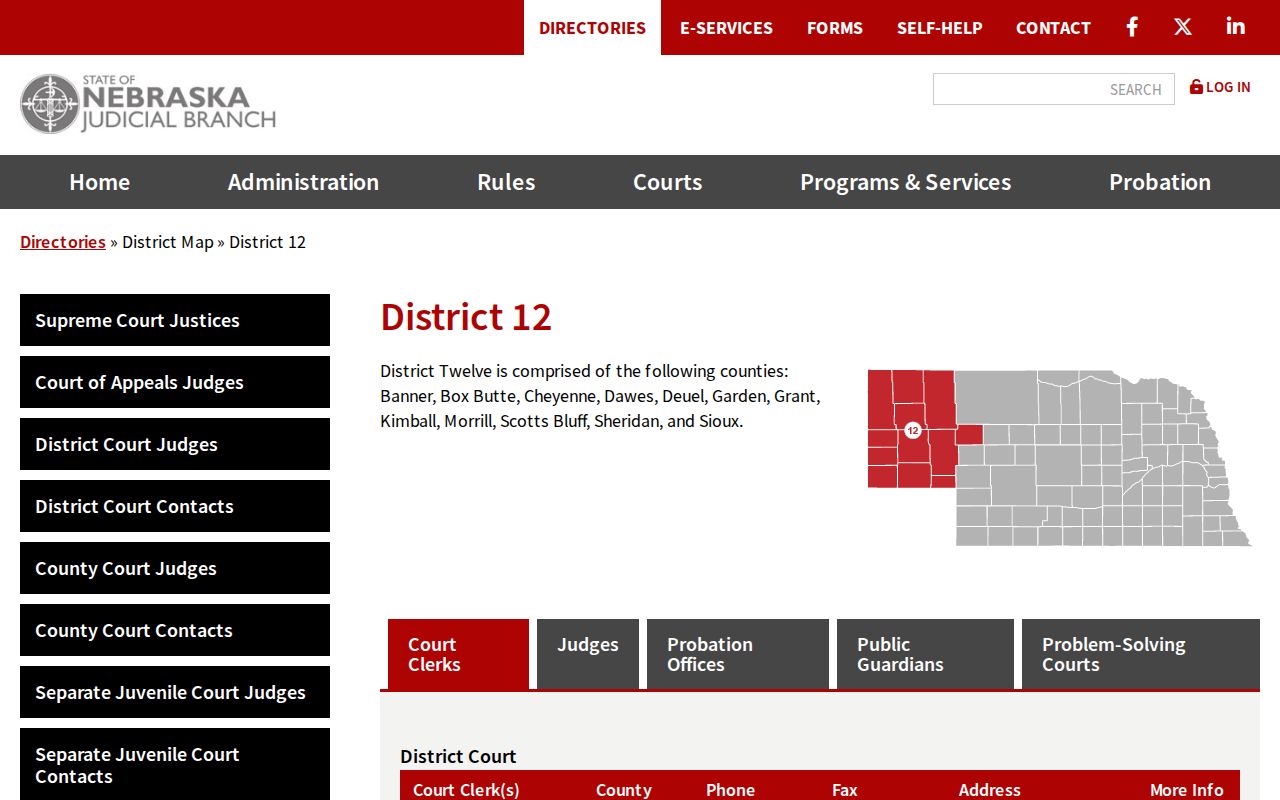
The regional listing helps a reader distinguish the clerk who holds the case from the place where a hearing may occur. Call before making a long rural trip because the official sources do not publish one dependable walk-in schedule for every Banner proceeding.
How to Search Case Records
The Nebraska Judicial Branch case-information service routes the public to JUSTICE. That system covers County and District Court cases in all 93 counties. It offers a paid one-time party-name search, a Nebraska.gov subscription, and free case-information kiosks at courthouses or public law libraries. JUSTICE is an index and docket service. It does not promise a downloadable image of every pleading, and certified Banner County court records still come from the clerk.
- Open the Judicial Branch case-information page and choose the one-time search, subscription service, or a courthouse kiosk.
- Enter the party name in the court format, select Banner County, and choose Criminal as the case type when offered.
- Narrow the result by birth date, filing year, court type, subtype, judge, or attorney when the name yields too many cases.
- Open the Banner County docket and read the court, case number, charges, event history, outcome, and sentencing entries.
- Give that case number to the correct clerk and ask about plain copies, certified records, archived items, and any fee before ordering.
The search fields documented by the official interface are more specific than a basic name box.
| Field Label | Type | Required | Notes |
|---|---|---|---|
| Party Name | Text | One criterion needed | Use Last, First, Middle, Suffix for a person; a last name alone is accepted. |
| Party Type | Radio | With name | Select Individual rather than Entity for a person. |
| Birth Date | Date | No | Helps narrow a common name. |
| County | Multi-select | With another field | Select Banner; an unbounded county-only search is not accepted. |
| Case Year | Dropdown | No | Use the known filing year when possible. |
| Court Type | Dropdown | No | Check both County Court and District Court for a felony path. |
| Case Type or Subtype | Multi-select | No | Choose Criminal and refine by the available subtype. |
Banner County Case Search Failures
A missing result can come from search form, not case status. JUSTICE uses the spelling entered by the court. A middle initial that does not appear in the court record can block the expected match. Try the last name first, then add the first name and other details one at a time. Preserve the “Last, First, M, Suffix” pattern and spaces when using the full name. Search both court types if the matter may be a felony.
Timing can also hide a new Banner County criminal case. Public search entries may lag court entry by 24 hours. The one-time result set returns no more than 30 cases, so a broad or common-name query may need a birth date, year, court, or criminal case type. JavaScript must be enabled for the search. If careful variants still yield nothing, call the relevant Banner clerk. A confidential juvenile matter, sealed file, or protected case data will not become public merely because a name is entered.
Note: A blank JUSTICE result does not prove that no Banner County case, warrant, or clerk-held file exists.
What the Case File Shows
A Banner County criminal court file is built around a case number and court docket. The docket is the dated list of events. It can show how the filed charge changed, when a plea was entered, which hearings occurred, and how each count ended. That focus differs from an arrest report, which describes an officer’s allegations, and from an NSP RAP, which compiles fingerprint-supported arrest cycles and reported outcomes.
The official JUSTICE demonstration and FAQ support the following field inventory. Not every public view displays every field, and the clerk must verify the official record.
| Case Number & Court | Identifies the Banner County or District Court file, case type, filing date, and case status. |
|---|---|
| Charging Document | States the complaint or information and the filed counts, which may differ from the arresting officer's allegations. |
| Docket Entries | Lists filings, appearances, motions, orders, plea events, trial activity, and later case action in date order. |
| Hearing Dates | Shows scheduled and completed events, subject to later court changes. |
| Disposition & Judgment | Records the outcome for the case or each count, such as conviction, dismissal, or acquittal. |
| Sentence & Conditions | May show incarceration, probation, fines, costs, restitution, and related public financial entries. |
Banner County Case Docket Limits
The online register of actions is useful, but it is not the full court folder. A result can list the caption, case type, party, judge, attorneys, filed charges, trial dates, events, outcome, and some public financial data. Detailed documents depend on public availability and the service tier. A line that says “motion filed” does not ensure the motion image can be opened. The clerk remains the source for the pleading itself and for certification.
The Judicial Branch’s statewide e-services overview shows the available case-access routes.
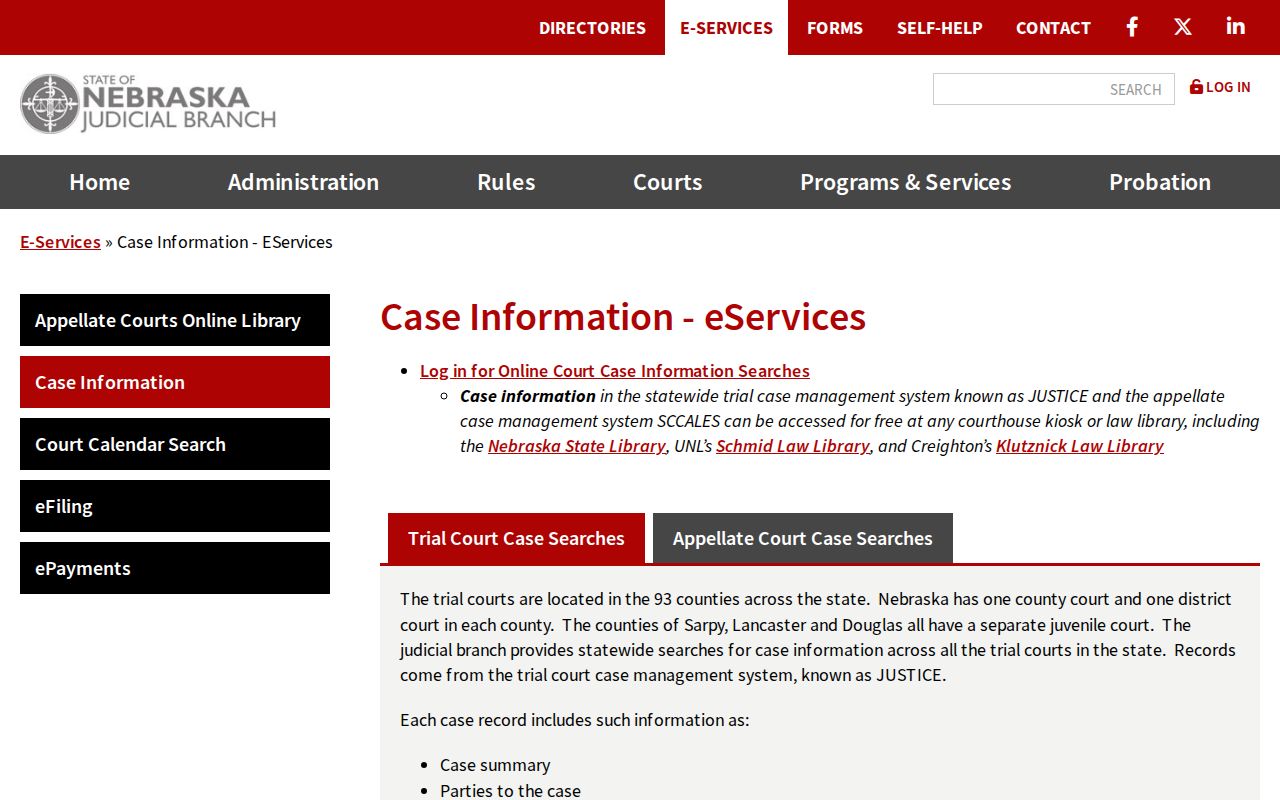
The statewide screen is the right starting point for public case data, while the Banner County clerk is the final stop for a complete or certified judgment. Public birth dates and identifiers may be suppressed or shortened, and sealed or confidential material does not appear.
Stages of a Criminal Case
A misdemeanor usually remains in County Court. A felony has a two-court route. It begins with County Court proceedings that may address the complaint, initial appearance, bond, and preliminary hearing. If probable cause is found or the preliminary hearing is waived, the felony moves to District Court for an information or indictment, arraignment, motions, plea or trial, judgment, and sentence. The exact pace depends on the filed case and court orders. No fixed Banner-specific initial-appearance promise should be inferred.
Case flow: Charges Filed → Arraignment → Pretrial → Plea or Trial → Disposition → Sentencing
Arraignment is the hearing where charges are presented and a plea is entered. Disposition means the outcome of a charge or case. A dismissal and an acquittal are both non-conviction results, but they arise in different ways. The docket and judgment should control any reading of the result.
Banner County Felony Case Records
A person tracing a Banner County felony should not stop after finding one number. The County Court complaint or preliminary file may document the first phase, while District Court carries the information, trial-level motions, disposition, and sentence. The prosecutor can amend the filed charge, so the court count may differ from the charge first stated at booking. Compare dates and party names, then ask the clerks whether the files are linked by a bindover.
This is also why a court case is not the same as a Nebraska State Patrol RAP cycle. A citation can create a court case without a fingerprint-supported state history entry. In contrast, an arrest can create an agency and fingerprint record before a prosecutor files any case. For the broader difference between those sources, the Banner County criminal history overview explains how sheriff, court, and state repository records fit together.
Access & Restrictions
Nebraska court records follow the Judicial Branch’s public access rules. Public access does not extend to every piece of data in every file. Protected identifiers, juvenile cases, sealed matters, victim-sensitive details, and other confidential content can be removed from the online view or withheld. A requester should ask whether a redacted public copy is available when only part of a document is protected.
Executive-agency records use a related but different route. Under Neb. Rev. Stat. §84-712, the public may inspect and copy qualifying public records, while §84-712.05 permits specified investigative and sensitive material to be withheld. Court files remain governed by court-access rules rather than treating each judicial record as an agency request.
For a certified Banner County judgment, contact the sentencing court and give the clerk the case number. Ask about the available format, certification, any archived record, and the current cost before ordering. No Banner-specific copy or certification fee schedule was found in the official sources, so a quoted amount should come from the clerk.